

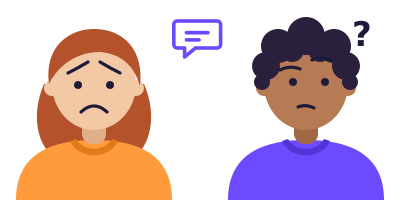
“Fine.” It is one of the shortest words in a relationship, and one of the easiest to misread.
When one partner says “fine” and means “I am hurt”, the other may hear exactly what was said: it is fine. Many autistic people take words at face value, so a hint can pass by without a trace. Nobody is being careless. You are simply using different codes.
Two meanings, one word
In many families, “fine” has a second meaning that nobody ever taught out loud. It can mean “I am upset, but I do not want to start a fight.” It can mean “please ask me again.” It can mean “I wish you had noticed.”
Many people learn this second meaning without ever being told. They pick it up from tone of voice, a look, a sigh. If you do not read those signals the same way, the word simply means what it says. And that is not a failure. It is a different way of listening.
It goes the other way too. An autistic partner who says “fine” may mean exactly that: everything is fine. If the other partner keeps searching for a hidden meaning, it can feel like not being believed.
Why hints get lost
A hint asks your partner to do three things at once: notice the signal, work out what it means, and guess what you need. That is a lot, even for people who find it easy.
When a hint is missed, both people usually end up hurt. The one who gave the hint feels ignored. The one who missed it feels blamed for something they could not see. Over time this turns into a small, quiet pile of misunderstandings.
The good news is that the fix is small, and it works for both of you.
Say the feeling, name the time
Replace the hint with a sentence that has three parts: the feeling, the need and the time.
Notice what the second sentence does. It names the feeling, so nobody has to guess. It says what you need, so your partner knows how to help. And it gives a time, so the waiting has an end.
You do not have to find perfect words. Short and plain is best. “I feel sad. I need some quiet. Can we talk after dinner?” is a good sentence.
If you are the one who hears “fine”
You can help too, and you do not need to be a mind reader. Ask one plain question instead of guessing:
- “Do you mean fine, or do you mean not fine?”
- “Is something bothering you? It is okay to say yes.”
- “Would you like to talk now, or later?”
Plain questions are kind. They tell your partner that you want the real answer, and that you will not be angry about it.
If the answer is “it is really fine”, believe it. Taking someone at their word is a form of respect.
When the words will not come
Sometimes the feeling is big and the words are far away. That is not a failure either. You can send a message, write a short note, or hold up a card with a number from one to five. “I am at a four” is a complete sentence. You can explain more later, when you are calmer.
Many couples find that having a way to say “not now, but later” makes the hard moments less lonely.
A small experiment for this week
Choose one small moment this week, something that does not matter too much, like which film to watch or who does the dishes. When you notice a feeling, say it in the three-part way: the feeling, the need, the time. Then ask your partner one question: was that clear?
Their answer will teach you more than any guide can. If it helps, agree on a short code for the days when words are hard, such as a colour, a number from one to five, or a card on the table.
You are not trying to change who you are. You are building a small bridge between two ways of speaking. One honest sentence at a time, it gets easier to cross.