

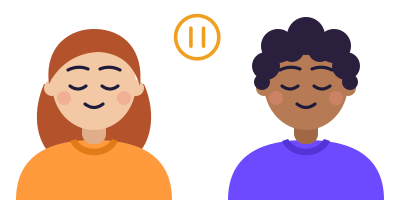
Every couple argues. What matters is what happens when the argument gets too big to handle. For many couples, one partner goes quiet and leaves the room, and the other is left standing there wondering what just happened.
It does not have to go like that. A pause can be one of the kindest things you do for each other, as long as it comes with a few clear words.
Why a pause helps
When an argument heats up, voices get louder, faces change and the pace speeds up. Many autistic people find that this is exactly when words start to disappear. Their mind may be racing, but the right sentence will not come. Sounds feel sharper. Thinking feels slow. Pushing on with the conversation makes it worse, not better.
For the other partner, it can look like silence, coldness or running away. It is not. It is a brain and a body at the end of what they can handle in that moment.
Neither of you is the problem. The problem is that the conversation has become too much for one of you, and nobody has said so.
A good pause has three parts
A pause is not a way out of the conversation. It is a short break inside it. Say these three things, in this order:
- It is a pause, not the end. “I need a pause.”
- How long it will be. “Twenty minutes.”
- When you will come back. “I will come back at eight, and we will finish talking.”
Here is how it sounds in real life:
The second version takes only a few more seconds. It tells your partner that you are not rejecting them, that you are safe, and exactly when to expect you.
Agree on it when things are calm
The worst time to invent a rule is in the middle of an argument. Sit down together on a quiet day and decide a few things:
- A pause phrase. One short sentence you both know, such as “I need a pause.”
- How long a pause can be. Twenty minutes to an hour works for many couples. Longer than a few hours starts to feel like avoiding the problem.
- What the other person does. Usually: do not follow, do not keep talking through the door, and do not send a stream of messages.
- Where each of you can go. A bedroom, a walk, a quiet corner with headphones.
Write it down if that helps. Many people find that a rule on paper is easier to trust than a rule in the air.
What to do during the pause
The aim of a pause is to calm your body, not to build your case. A few ideas:
- Move somewhere quiet, or somewhere with fewer people and less noise.
- Do something that settles you: a walk, slow breathing, a favourite show, music, a stim that feels good.
- Drink some water. Eat something if you are hungry.
- Do not replay the argument again and again. If it keeps coming back, write down the one thing you most want your partner to understand.
If you are the partner who is waiting, do something kind for yourself too. Make tea. Go outside. Remind yourself that the pause is not a sign that something is broken. It is a sign that the plan is working.
Coming back is the most important part
A pause only works if you return when you said you would. If you are not ready, say so before the time is up and set a new time. A short message such as “I need ten more minutes, I will be back at 8:30” keeps the trust.
When you come back, go slowly:
- Start with something small and kind. “Thank you for waiting.”
- Say what you need, in one sentence.
- Ask your partner to say what they heard. Then ask what they need.
- Take one topic at a time. If a new one appears, write it down for later.
What if the pause keeps getting ignored?
Sometimes one person says the pause phrase and the other keeps talking. If that happens, say it once more, calmly, and go. Then, when you are both calm, talk about it: “When I asked for a pause and you kept going, I felt trapped. Can we agree that the pause phrase means we both stop?”
If you are the one who tends to follow, try to notice the urge. It usually comes from fear that the problem will not get solved. Remind yourself of the return time. The conversation is not over. It is only resting.
A note on safety
A pause is for two people who both want to find a way through. If you ever feel afraid of your partner, or you are being controlled, threatened or hurt, a pause is not the answer. Please reach out to a trusted person or a local support service.
Try it once this week, on something small. A disagreement about dinner is a good place to practise. Then ask your partner one question: did that feel safe and clear? Their answer will tell you more than any guide can.